Tutorial - Plate Creation From Vials
Introduction
In this tutorial, you will be guided to transfer 20 copies of 4 vials (VTEST011 to VTEST014) to create a 96-well plate.
Prerequisites
Required permissions and setup
Sample Processing role is required to access this workflow.
Required system configuration:
- Container Types:
Greiner PP96V, - Container Usage
Inventory, - Solvent
DMSO, -
Worklist Generator and Parser:
Standard (Well) (;), -
Filling Layout:
MIN(1) - MAX(12) (column filling),
These should exist by default in the Sample application.
Items
Containers and locations created from Discngine Sample’s automation will be used:
- Vials VTEST011 to VTEST014
- Location
ParisAutomation is running during installation if “example_dataset” is set to true in the configuration file.
Workflow
Job Initialization
Create a new job and select the Plate Creation from Vials workflow.
Requesting
- Select Vial as Source Type
- Specify Request from Text
- Copy/paste the vial names in the text area: VTEST011:VTEST012:VTEST013:VTEST014 (Vial names can be separated by colons or line breaks.)
- Click
Add IDsto confirm. The vials are listed in the added requests. - Click
Next
Task Requesting
- Choose Source Selection Mode = All sources
- Select Number of Copy = 20
- Target Volume = 30 μl
- Dilution = Target
- Dilution Mode = Dilution Factor
- Dilution Factor = 10
- Buffer (Solvent) = DMSO
- Offset Volume = 0%
- Offset Solvent = 0%
- Click
Add Task. Twenty tasks are added (one for each copy). - Click
Next
Sourcing
The Sourcing page will confirm that the requested operations are compatible with the source vials (information in the Sourced column).
- Click
Next
Target Requesting
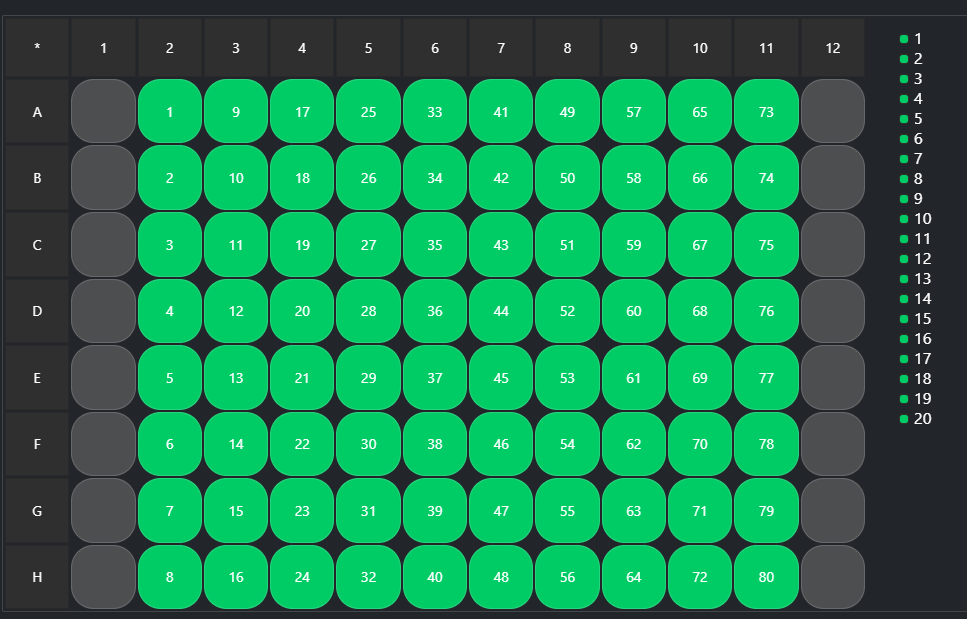
The Target Requesting step is where you define the plates you will use as output for your job. Choose the type of plate to use, the way they will be filled, and their usage. The tasks added earlier are translated into robotic moves and appear in the "Expected Moves" report (20 tasks over 4 vials = 80 moves to handle).
- Select Greiner PP96V plates as Target Plate Type
- Keep the filling order to By Source
- Click
Add Plateand choose to Autocomplete with New Plates - Choose to use the layout MIN(1) – MAX(12) (column filling) and Inventory as the Target Usage
- Click
Add
A single plate has enough space to map all 80 moves.
- Click
Next
Processing
For processing, requested tasks are translated into a worklist that you can feed to your robotic equipment.
- Select the Standard (Well) (;) equipment
- Click
Generate worklist
A worklist file appears in the Worklist Generator area. It contains the requested tasks to execute. The Worklist Parser area expects a file containing the information about the tasks that were actually completed. By default, the generated file is set in the Worklist Parser. For this tutorial, we assume that every task was completed successfully, so we’ll keep this default file.
- Click
Copy Worklist - Click
Nextto propagate those changes in the system. The tasks are processed in the Sample application.
Storing
The Storing step allows you to assign a location to the items involved in the job. First, for the output plates (plates created during the job).
- Click
Assign Location to Selected - Select Paris and click
Selectto confirm your choice. - Click
Nextto continue to the input vials. Here, we won’t change the input vials location. - Click
NextYou can increment the Thawing Cycle count of the input plates if necessary.
Pipe & Close
The Pipe & Close step provides a summary page where you can review the job and optionally pipe it to another workflow. You can also pipe this job to another one, allowing you to immediately start a new job using the output or the input plates from this one.
For this tutorial, click the Close & Quit button to finish the job.